
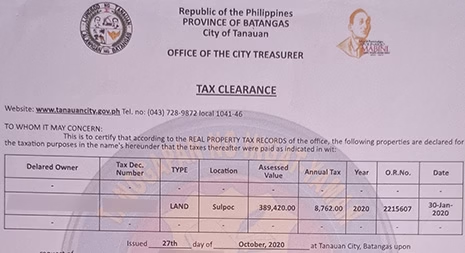
After a property tax payment is made, the final document you’ll need from the local government is the Tax Clearance Certificate. While the Real Property Tax Receipt proves a single payment, this certificate is a comprehensive official statement that all past and present taxes on the property have been paid.
Think of it as a “clean bill of health” for the property’s tax history. It’s the local government’s official stamp of approval saying, “This property is up to date on all its taxes.”
What Exactly Is a Tax Clearance Certificate?
In simple terms, the City or Municipal Treasurer’s Office issues this official document. It certifies that you paid all Real Property Taxes (RPT), or Amilyar, in full for the current year.
Essentially, it proves to the government and the buyer that the property carries no outstanding tax debts. Without this proof, the state could eventually auction the land to recover unpaid dues.
Tax Clearance vs. Land Title
First-time investors often mistakenly believe that holding the Land Title (TCT or CCT) is sufficient. However, they serve different purposes:
-
The Land Title: This acts as your proof of ownership. It defines who the legal owner is and describes the physical boundaries.
-
The Tax Clearance Certificate: This serves as your proof of financial compliance. It shows that you fulfilled your obligations to the local government.
Expert Tip: You can own a property but still remain “delinquent.” You cannot transfer the title without this clearance.
The Workflow: Where It Fits in the Title Transfer Process
The Philippine title transfer process functions like a relay race. Therefore, you must pass the tax clearance baton early.
-
Local Transfer Taxes: First, you visit the Treasurer’s Office after notarizing the Deed of Absolute Sale.
-
Securing the Clearance: You present the latest Tax Declaration and official receipts to obtain the certificate.
-
BIR Processing: Next, you take the document to the BIR to process the eCAR.
-
The Register of Deeds: Finally, the RD issues the new title once they verify all local and national taxes.
Red Flags: Common Errors to Watch For
Even a small typo can invalidate your entire application. Thus, you should check these four items immediately:
-
Mismatched Names: Ensure the name matches the TCT and Tax Declaration exactly. Even a missing initial causes delays.
-
Lot and Block Numbers: Carefully verify that the survey coordinates align perfectly with the original Title.
-
Current Year Validity: Most clearances expire at the end of the quarter or year. Check the date before filing.
-
Tax Declaration Number: Confirm the clearance refers to the most recent assessment rather than an old, cancelled version.
Final Words of Advice
Do not wait for a buyer before you check your tax status. If you discover unpaid taxes from previous years, penalties will accumulate quickly.
Pro-Tip: Always keep a dedicated folder for your original Official Receipts (ORs). Having these records makes the application process significantly faster.
Real estate remains the safest investment in the Philippines if your documentation is bulletproof. Stay diligent and always verify facts before you sign.
Want to master the rest of the transfer process? Explore our Real Estate Title Transfer Resource Center