
Is the “Amilyar” Paid? Why Real Property Tax Receipts Are Vital for Property Buyers
When buying land or a house in the Philippines, a Real Property Tax (RPT) Receipt is far more than just a proof of payment. It is a critical legal shield. Locally known as the “Amilyar” receipt, this document is the definitive proof that the seller has settled their annual financial obligations with the local government.
If you are currently in the due diligence phase of a property purchase, here is everything you need to know about verifying tax receipts to ensure a smooth title transfer.
What is a Real Property Tax Receipt?
An RPT Receipt is an official document issued by the Treasurer’s Office of the city or municipality where the property is located. It confirms that the taxes for a specific parcel of land or building have been settled for a specific year or quarter.
Your “Ticket” to a Successful Title Transfer
In the Philippines, you cannot complete a legal property sale without this document. The Bureau of Internal Revenue (BIR) strictly requires proof of updated tax payments before they issue the Certificate Authorizing Registration (CAR). Without the CAR, the Registry of Deeds will not transfer the title to your name.
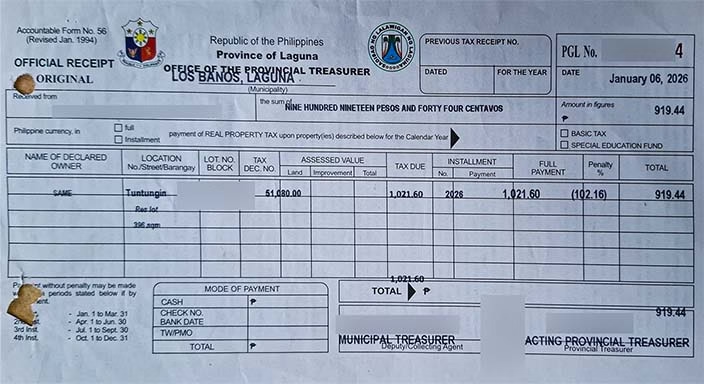
Anatomy of a Tax Receipt: 5 Key Areas to Verify
Do not just glance at the receipt—audit it. To protect your investment, cross-examine these five sections:
- Official Receipt (OR) Number
- The Check: Ensure it is a pre-printed or system-generated number from the Municipal/City Treasurer. Verification of this number ensures the document isn’t a fake or a mere “acknowledgment” slip.
- Date of Payment
- The Check: Real property taxes are paid annually or quarterly. Ensure the date is recent. An old receipt from two years ago does not prove the property is currently clear of debt.
- Property Owner’s Name and Address
- The Check: The name on the receipt must match the seller’s name on the Title (TCT). If a different name appears, demand a Special Power of Attorney (SPA) or legal documents explaining the discrepancy (such as an inheritance).
- Property Details (TD and PIN)
- The Check: This is the most critical step. Match the Tax Declaration (TD) Number and the Property Identification Number (PIN) against the Title.
Warning: It is common for sellers to accidentally provide a receipt for an adjacent lot or a different unit. Always verify the specific lot and block numbers.
- Payment Amount and Period Covered
- The Check: The receipt must show payment for the current full year. If there are “delinquencies” or unpaid years, the seller must settle these—including hefty interest penalties—before you release the final payment.
Why This Receipt is Mandatory for Buyers
- Stop Inheriting Debt: Property tax debts follow the land, not the person. If you buy a property with 5 years of unpaid taxes, you become liable for those taxes and penalties the moment you own it.
- BIR Compliance: As mentioned, the BIR will halt your transfer process immediately if taxes are not updated.
- Technical Alignment: It serves as a “triple check” ensuring the Tax Declaration, the Title, and the physical property all refer to the same piece of land.
Frequently Asked Questions (FAQ)
What if the seller lost the original tax receipt?
The seller must secure a Tax Clearance from the City or Municipal Treasurer. This document is a formal certification that the property has no outstanding tax liabilities. It is often more powerful than a simple receipt and is highly preferred by banks and the BIR.
Can I pay the “Amilyar” even if I’m not the owner yet?
Yes. LGUs generally accept payments from anyone as long as they have the Tax Declaration number. However, paying the tax does not give you ownership rights. If you are paying on behalf of a seller, ensure it is documented in your “Memorandum of Agreement.”
Does a Tax Receipt prove I own the land?
No. While it is strong supporting evidence, the Transfer Certificate of Title (TCT) is the only ultimate proof of ownership in the Philippines. A tax receipt proves you are a responsible taxpayer, but the Title proves you are the owner.
What if the receipt says “Vacant Lot” but there is a house on it?
This is a major red flag. If a house exists but isn’t declared, the seller must first declare the “improvement” at the Assessor’s Office and pay the corresponding back taxes. You cannot transfer the title of a house that “officially” doesn’t exist.
When is the best time to pay Property Tax?
In the Philippines, most LGUs offer discounts of 10% to 20% if you pay between January 1 and March 31. As a buyer, always ensure the seller has taken advantage of this or settled the full amount before the sale.
Pro-Tip for Buyers: Always request a Tax Clearance in addition to the receipts. While the receipt shows a payment was made, the Clearance certifies that no other debts exist for that property.
Looking for assistance with property title transfers in Laguna? Visit our Property Learning Center for more guides.