
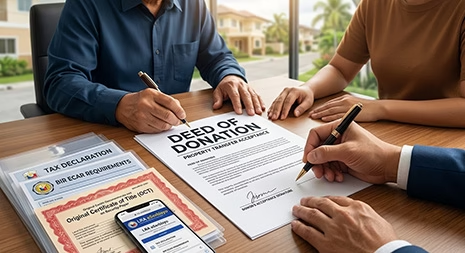
How to Transfer Property via Deed of Donation in the Philippines: A Step-by-Step Guide
Gifting a piece of land, a family house, or a condo unit to your children or relatives is a significant milestone. Many property owners choose to give their properties away out of love and generosity. In the legal and real estate world, this specific process is called a property transfer via donation.
Many people assume that because a property is given as a gift, the process is free, automatic, and simple. This is a common misconception. Giving away real estate involves a formal legal process. It requires coordination with multiple government offices, strict adherence to tax deadlines, and the submission of specific documents.
If you are the person giving the property, or if you are the fortunate person receiving it, you must understand how this transfer works. Skipping steps or ignoring tax laws can result in heavy cash penalties, frozen titles, and long delays. This guide breaks down the entire process into plain, simple steps that anyone can follow.
What is a Deed of Donation?
A Deed of Donation is a formal, written contract where a property owner transfers real estate to another person completely free of charge. To make it easy to understand, let us look at the two roles involved in this contract:
- The Donor: This is the current registered owner of the property who decides to give the asset away as a gift.
- The Donee: This is the person who receives the property gift from the owner.
For a donation to be valid in the Philippines, it cannot be a simple verbal agreement. You cannot just hand over the physical copy of the land title and consider the transfer complete. The law requires a specific written contract.
This contract must contain two vital parts to be legally binding:
- The Offer of Donation: The property owner must state clearly in writing that they are giving the property to the receiver out of pure generosity, without demanding any monetary payment.
- The Acceptance of Donation: The receiver must explicitly state in writing, within the same document or in a separate formal paper, that they accept the property gift.
If the receiver does not sign the acceptance section during the lifetime of the owner, the donation is legally invalid. The government will not allow you to change the name on the title.
Donation vs. Sale: What is the Difference?
A Deed of Absolute Sale is used when money changes hands between a buyer and a seller. A Deed of Donation is used when no money is involved.
Even though no money changes hands during a donation, the government still views the transfer as a taxable event. The state charges a tax because a valuable asset has changed ownership. The type of tax you pay, the deadlines, and the documents you submit differ significantly from a standard property sale.
The Step-by-Step Property Transfer Process
Transferring a land title from the original owner to the receiver requires visiting several government offices. You cannot skip any of these offices, as each office provides a specific clearance needed by the next agency.
Here is the step-by-step path you must take to complete the transfer successfully.
Step 1: Prepare and Notarize the Deed of Donation
The first physical step is to get the contract written down. You must hire a professional or a lawyer to draft the Deed of Donation.
- The document must copy the exact technical description of the land found on the current face of the title. Every letter, number, boundary line, and punctuation mark must match perfectly.
- The contract must state the full names, civil status, and addresses of both the giver and the receiver.
- Both parties, along with two witnesses, must sign the document.
- Take the signed document to a Notary Public to have it notarized. Notarization converts the paper into a public document, which government agencies require before they accept your application.
Step 2: Secure Certified True Copies of the Property Documents
Once your contract is notarized, you must gather updated records of the property from your local city hall or municipal hall.
- Visit the Assessor’s Office in the municipality where the land is physically located. Request a Certified True Copy of the latest Tax Declaration for the land. If there is an existing house or structure on the land, you must also secure a Tax Declaration for the improvement.
- If the land is completely vacant, request a formal Certificate of No Improvement from the same office.
- Visit the Municipal Treasurer’s Office and pay the current year’s real property tax, commonly known as amilyar. Obtain an official receipt and request a Real Property Tax Clearance. This document proves the property has no outstanding tax debts with the local government.
Step 3: File and Pay Taxes at the Bureau of Internal Revenue (BIR)
This is the most critical stage of the transfer process. You must submit your documents to the specific BIR Revenue District Office (RDO) that holds jurisdiction over the location of the property.
- The BIR will compute two specific taxes: Donor’s Tax and Documentary Stamp Tax (DST).
- The Donor’s Tax rate is a flat 6% of the property’s total value.
- The Documentary Stamp Tax is 1.5% of the property’s total value.
- The BIR does not base these percentages on what you want the property to be worth. They will look at the BIR Zonal Valuation and the Fair Market Value on your Tax Declaration. They will use whichever figure is higher as the basis for the tax.
- Fill out BIR Form 1800 for the Donor’s Tax and BIR Form 2000-OT for the DST using the electronic eBIRForms system.
- Pay the computed amounts through an Authorized Agent Bank (AAB) accredited by that specific BIR branch.
Step 4: Wait for the Issuance of the eCAR
After paying the taxes, submit your official bank receipts and your complete document bundle back to the BIR ONETT (One-Time Transaction) window.
- The BIR officers will review your documents to verify that your payments match the true value of the land.
- Once approved, the BIR will release the Electronic Certificate Authorizing Registration (eCAR).
- The eCAR is a document with a unique official barcode. It serves as the official green light from the national government, proving that all taxes for this property transfer have been settled fully. The Registry of Deeds will never transfer a title without this document.
Step 5: Pay the Local Transfer Tax at the Provincial or City Treasurer
With your BIR eCAR in hand, head back to your local government unit.
- If the land is in a municipality, go to the Provincial Treasurer’s Office located at the provincial capitol. If the land is inside a chartered city, go directly to the City Treasurer’s Office.
- You must pay the Local Transfer Tax. The rate varies slightly by location but generally ranges between 0.5% to 0.75% of the property value.
- The local treasurer will check your eCAR, collect the payment, and issue a Transfer Tax Receipt along with a local tax clearance for the title transfer.
Step 6: Register the Transfer at the Registry of Deeds
This is the final office visit. Take your entire compilation of original clearances, receipts, and contracts to the Registry of Deeds (RD) for the province or city where the land is located.
- The RD staff will examine your documents, confirm the eCAR barcode online, and calculate the registration fees.
- Pay the required Registration Fees at the RD cashier window.
- An examiner will review the file. If everything is correct, the RD will cancel the old Original Certificate of Title (OCT) or Transfer Certificate of Title (TCT).
- The RD will print a brand-new title bearing the name of the receiver.
Step 7: Update the Tax Declaration Name at the Assessor’s Office
Many people make the mistake of stopping after getting the new title from the Registry of Deeds. Your transfer is not complete until you update the tax records.
- Take a photocopy of your newly issued land title back to the Municipal or City Assessor’s Office.
- Apply for a New Tax Declaration under the name of the new owner.
- This ensures that future amilyar billing statements are sent directly to the correct person and that local government property records match the land title perfectly.
Critical Warnings: Avoid These Costly Mistakes
Over three decades of working with property transfers, I have seen many family transactions fall apart because of simple oversights. Pay close attention to these common pitfalls so you can protect your hard-earned money and avoid legal trouble.
-
The 5-Year Pre-Patent Prohibitory Period
If the property you want to give away was acquired through a government grant, such as a Free Patent Title or a Homestead Patent, it is governed strictly by the Public Land Act.
- Older public land patents carry a strict 5-year prohibitory period. From the exact date the patent was signed and issued by the government, the owner cannot sell, mortgage, or donate the land to anyone.
- If you sign a Deed of Donation within that 5-year window, the contract is legally null and void. The Registry of Deeds will reject your transfer application immediately.
- Always inspect the front page of the land title. Look for the text that states how the land was acquired. If it mentions a free patent, check the transcription date before moving forward. Note: Newer residential free patents granted under Republic Act No. 10023 have more lenient terms, but you must still verify the dates with an expert to ensure safety.
-
Missing Spousal Consent
If the person giving the land away is legally married, another layer of law applies. Under Philippine family law, properties acquired during a marriage are generally part of the couple’s shared community property or conjugal partnership.
- Even if only one name appears as the owner on the face of the land title, the property might still belong to both husband and wife.
- The owner’s spouse must provide written consent to the donation. This consent is usually written directly into the Deed of Donation as a specific section where the spouse signs to agree to the gift.
- If you attempt to donate real estate without the husband or wife’s written consent, the Registry of Deeds can halt the registration. Furthermore, the unconsenting spouse can file a court case to cancel the transfer later on.
-
Missing the Strict 30-Day BIR Deadline
The Bureau of Internal Revenue follows strict electronic clocks. Once you sign and notarize a Deed of Donation, a countdown begins.
- You must file the tax return and pay the corresponding Documentary Stamp Tax (DST) within 5 days of the following month after the notarization date, while the Donor’s Tax must be filed and paid within 30 days from the date of notarization.
- If you let the deadline pass without filing and paying, the BIR will automatically apply a 25% surcharge on top of your total tax bill.
- They will also add annual interest and compromise penalties. These penalty fees accumulate quickly and can easily double the amount of money you need to pay before you can get your eCAR. Do not notarize your document until you have the cash ready to settle the taxes at the bank.
-
Failure to Verify the Original Title
Never transfer a property based solely on a photocopy of a land title provided by a relative or acquaintance.
- The physical copy kept at home might look clean, but it could have hidden issues. The property might have been used as collateral for a bank loan, or it could have a pending court claim registered against it.
- Always secure an updated Certified True Copy directly from the Registry of Deeds or through the official LRA eSerbisyo portal before you draft any paperwork. This lets you inspect the back pages of the title for any active encumbrances or restrictions.
Document Checklist for a Smooth Transfer
To save time and avoid making multiple trips to different government offices, prepare your documents in advance. Make three separate photocopy sets of every item on this list. Keep one set for your personal files and submit the others to the respective agencies.
Core Documents for the Legal Contract:
- [ ] Original Owner’s Duplicate Copy of the Land Title (OCT or TCT)
- [ ] Notarized Original Deed of Donation (Must include the signed Acceptance Clause)
- [ ] Valid, unexpired government-issued IDs for the Giver (Donor)
- [ ] Valid, unexpired government-issued IDs for the Receiver (Donee)
- [ ] Tax Identification Number (TIN) Verification Slips for both parties
- [ ] Notarized Special Power of Attorney (SPA) if a representative is processing the papers
Local Government Documents (City or Municipal Hall):
- [ ] Certified True Copy of the Latest Tax Declaration for the Land
- [ ] Certified True Copy of the Latest Tax Declaration for Improvements (House/Building)
- [ ] Official Certificate of No Improvement (Required if the land is raw and vacant)
- [ ] Official Real Property Tax Clearance (Proving current year amilyar is paid)
- [ ] Official Receipts of the current year’s real property tax payments
- [ ] Lot Plan or Subdivision Plan (Required if you are only donating a specific portion of the land)
Bureau of Internal Revenue (BIR) Requirements:
- [ ] Printed BIR Form 1800 (Donor’s Tax Return filed via eBIRForms)
- [ ] Printed BIR Form 2000-OT (Documentary Stamp Tax Return)
- [ ] Official Bank Validation Receipts from the Authorized Agent Bank
- [ ] Official BIR eCAR (This will be issued to you after review)
Registry of Deeds and Final Transfer Requirements:
- [ ] Official Local Transfer Tax Receipt (Issued by the Provincial or City Treasurer)
- [ ] Official Registration Fee Payment Receipt from the Registry of Deeds
Need Expert Help with Your Property Transfer?
Handling a property transfer via donation requires zero errors. One misspelled name, an incorrect technical description, or a missed tax deadline can lead to rejected applications and expensive penalties. Most common property owners do not have the time to stand in long government lines or decipher complicated tax tables.
If you want to ensure your land title transfer is processed smoothly, legally, and without unnecessary stress, you can rely on professional guidance. We can help you check your land title for restrictions, draft a legally sound Deed of Donation, calculate your exact tax liabilities, and manage the submission process at the BIR and Registry of Deeds.
Take a moment to explore our blog for more practical guides on dealing with local land issues, or read our guide on title verification to learn how to check the status of your land records online. For personalized assistance, you can reach out to our team today so we can review your specific property situation.
Keep an eye out for our upcoming educational releases designed to help local owners manage their real estate portfolios efficiently. If you want to protect your family’s real estate assets, feel free to bookmark this platform and return to check our latest updates regularly.