
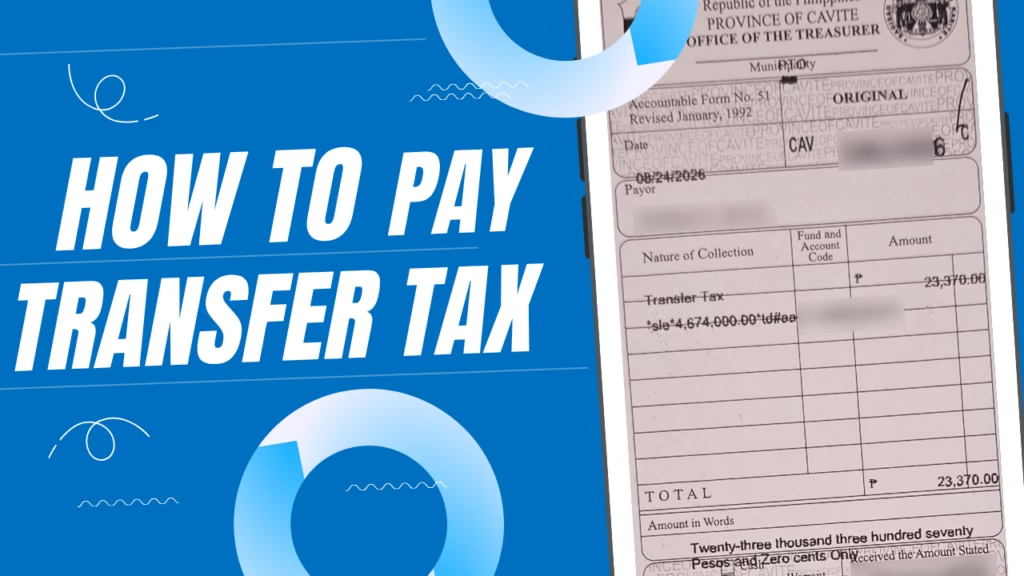
Buying or selling property in the Philippines brings total excitement. However, shifting the title from seller to buyer requires strict legal work.
You must clear several local government requirements before you secure a new land title. Paying your Local Transfer Tax is a central milestone in this legal process.
This complete guide breaks down the exact steps to pay your property transfer tax without stress.
1. What is Transfer Tax?
Transfer Tax is a local tax on passing property ownership from one person to another.
The local government collects this tax whenever property changes hands. This applies to land sales, property donations, and legal land inheritances.
You pay this tax directly to the City or Municipal Treasurer’s Office. The property location determines which local office handles your payment.
Do not confuse this local payment with national taxes paid to the Bureau of Internal Revenue. The BIR collects national taxes like Capital Gains Tax and Documentary Stamp Tax.
Meanwhile, your local city hall collects the Transfer Tax. Both payments remain mandatory before getting your new title.
2. Transfer Tax Rates and Calculation
Local government units set their tax rates based on standard national legal limits.
-
Provinces: Up to 0.50% of the total property valuation.
-
Cities and Metro Manila: Up to 0.75% of the total property valuation.
Local tax officers assess your property using three distinct price values. They always compute the final tax using the highest value among these choices:
-
Gross Selling Price listed on your notarized deed of sale.
-
BIR Zonal Value listed on official revenue records.
-
Assessed Value listed on your local tax declaration document.
Simple Calculation Formula
Consider a city property sold for ₱3,000,000 with a BIR zonal value of ₱3,500,000.
The local evaluator selects ₱3,500,000 because it represents the highest official value.
You will pay ₱26,250.00 directly to the city cashier for this transaction.
3. Mandatory Deadlines and Penalties
The government enforces strict deadlines for paying this local tax on time.
You must pay your tax within 60 days from your deed notarization date. Estate transfers count 60 days starting from the property owner’s passing date.
Missing this strict window triggers immediate financial penalties from the local treasurer:
-
Surcharge: An automatic 25% penalty on your main tax balance.
-
Monthly Interest: An extra 2% monthly interest until you settle the balance.
Delaying your payment increases overall expenses rapidly. Acting quickly protects your hard-earned money from unnecessary local government penalties.
4. Documentary Requirements
Gathering complete legal documents prevents painful delays at the municipal counter.
Bring original copies alongside complete photocopies of these core documents:
-
Notarized Deed of Absolute Sale or legal conveyance paper.
-
BIR eCAR (Electronic Certificate Authorizing Registration) with official tax payment receipts.
-
Latest Tax Declaration issued by the local assessor office.
-
Real Property Tax Clearance confirming fully settled annual land taxes.
-
Official Property Title (Transfer Certificate of Title or Condominium Certificate of Title).
-
Valid Government IDs belonging to both buyer and seller.
-
Notarized Special Power of Attorney if an authorized agent assists you.
5. Step-by-Step Procedure to Pay Transfer Tax
Navigating municipal offices requires clear focus and patience. Follow these specific actions to complete your local tax payment smoothly.
Step 1: Secure Your BIR eCAR First
Complete your national tax obligations at the Bureau of Internal Revenue first. The local treasurer requires your official BIR eCAR before accepting local tax payments.
Step 2: Pay Real Property Taxes
Visit the local treasurer to settle any unpaid annual real property taxes. Request an official RPT Clearance proving your property holds zero tax balance.
Step 3: Present Documents for Tax Assessment
Submit your complete document set to the local real property tax evaluator. The evaluator checks property values and prints your official Tax Order of Payment.
Step 4: Pay the Assessed Transfer Tax
Proceed directly to the official cashier window with your payment order. Pay your exact tax amount using cash or an approved cashier’s check.
Step 5: Collect Your Official Receipt
Secure your original Transfer Tax Official Receipt from the cashier immediately. Verify that your name, title number, and property details match your documents correctly.
Got Questions About Your Property Transfer?
Have you faced confusing requirements while dealing with city hall tax offices? Drop your thoughts, questions, or personal experiences in the comment section below!
6. What Happens After Paying Transfer Tax?
Paying your local transfer tax brings you closer to your final goal. However, key legal administrative steps still remain before completing the full transfer.
First, take your tax receipt and eCAR to the Registry of Deeds. Pay the necessary entry fees to register your newly notarized deed.
The Registry of Deeds cancels the old title and issues a new title. This new title bears the buyer’s full legal name.
Next, take your new title back to the City Assessor’s Office. Request a new Tax Declaration under the buyer’s name to finish the process.
Key Takeaways for Property Buyers & Specialists
Transferring property titles remains a rigorous process involving tight deadlines and multiple government counters.
-
Check exact city tax rates early to prepare your budget correctly.
-
Monitor your 60-day deadline carefully starting from your notarization date.
-
Keep duplicate copies of every tax receipt and government clearance paper.
Handling legal land transfers requires steady attention, time, and specialized expertise. Working alongside a seasoned professional prevents costly mistakes, avoided penalties, and wasted trips.
When you need trusted guidance for your property journey, Provdia serves as your reliable partner for title transfers and documentation needs. Explore our comprehensive resources today to simplify your property journey!