
The Smart Way to Transfer Land Titles in the Philippines: Save Your Money, Time, and Peace of Mind
Buying or selling land is a massive milestone for any Filipino family. You work hard for years to save up your money. Then you find the perfect lot in beautiful places like Laguna. Finally, you sign the purchase papers.
The seller receives the full payment. The buyer gets the physical lot. Most people think that the transaction ends right there.
That is a huge misconception. The truth is that signing the contract is just the first step. The most critical phase happens after the sale. You must change the name on the land title. This process is called a land title transfer.
In my 20 years of working inside real estate, I see people fall into traps. They assume the paperwork is simple. They try to do it themselves to save money.
Then, they run into massive government delays. They encounter unexpected fees and heavy fines.
Transferring a title requires moving paperwork through multiple government agencies. Each office has its own set of rules. They have long lines and strict timelines. If you make one mistake, the whole process stops completely.
This comprehensive guide breaks down exactly what happens during a title transfer. We look at it from the perspective of both the buyer and the seller. You will learn the exact steps and the common roadblocks.
You will see why a professional service like Provdia protects your hard-earned money. Let us explore how to navigate this system properly.
The Two Sides of a Sale: Who Pays for What?
Before we visit the government offices, we must talk about the division of expenses. Many arguments happen because parties do not clarify who pays for which tax. The law and local customs have standard rules for this division.
Let us look at what the buyer and the seller must pay.
The Seller’s Responsibilities
If you are the seller, your main job is to prove clean ownership. You must provide the original copy of the land title. You must also clear any outstanding bills on the property.
- Capital Gains Tax (CGT): This is a tax on the profit from selling the land. It is equivalent to 6% of the property value. By custom, the seller pays this tax.
- Real Property Tax (Amilyar): You must pay the annual property tax up to the sale date. You cannot transfer a land title if you owe money to the local government.
- Unpaid Utilities: If the property has existing dues, the seller must clear them before turn-over.
The Buyer’s Responsibilities
If you are the buyer, you pay for the documentation costs.
- Documentary Stamp Tax (DST): This is a tax on the agreements of the sale. It is equivalent to 1.5% of the property value. The buyer usually pays this.
- Transfer Tax: This is a fee paid to the local provincial or city government. It is around 0.5% to 0.75% of the property value.
- Registration Fees: This is the fee paid to print the new title. It follows a specific government table based on the price.
- Incidental Expenses: This includes notary public fees, photocopies, and processing costs.
Write these agreements down clearly in your initial contract. Misunderstandings here delay the entire process before you reach government offices. You can read our guide on property contracts to learn how to draft these terms correctly.
The Strict Clock of Bureaucracy and the 25% Penalty
The biggest shock for most people is the speed of government deadlines. The government does not care if you are busy with your job. The moment you sign and notarize your sale contract, a countdown timer starts.
The Bureau of Internal Revenue (BIR) enforces rigid deadlines for transfer taxes. Let us look at the two primary taxes that face strict deadlines.
The Capital Gains Tax Deadline
You must file and pay the Capital Gains Tax within 30 days from notarization. Many people count from the day they move into the property. That is a mistake.
The BIR looks at the stamp of the notary public. If you signed the document on June 1, your deadline is June 31.
The Documentary Stamp Tax Deadline
The Documentary Stamp Tax has an even tighter window. You must pay this tax on or before the 5th day of the following month.
If you notarize your deed on June 28, your deadline is July 5. That gives you only a few days to compile your documents.
The Cost of Being Late
If you miss these deadlines by even one day, the BIR applies heavy penalties.
- Surcharge: An automatic 25% surcharge penalty is added directly to your tax amount. If your tax bill is 100,000 Pesos, you owe an extra 25,000 Pesos instantly.
- Interest: The government adds compounding interest on top of the unpaid tax every single day.
- Compromise Penalty: An additional flat fee is charged based on the transaction value.
When you do this yourself, you spend weeks just figuring out forms. By the time you get to the front of the line, deadlines pass. Your original tax bill explodes.
Provdia tracks these deadlines using automated systems. We prepare the documents before the notary stamp dries. We protect you from paying thousands of Pesos in useless penalties.
The Critical Roadblock: Securing the eCAR
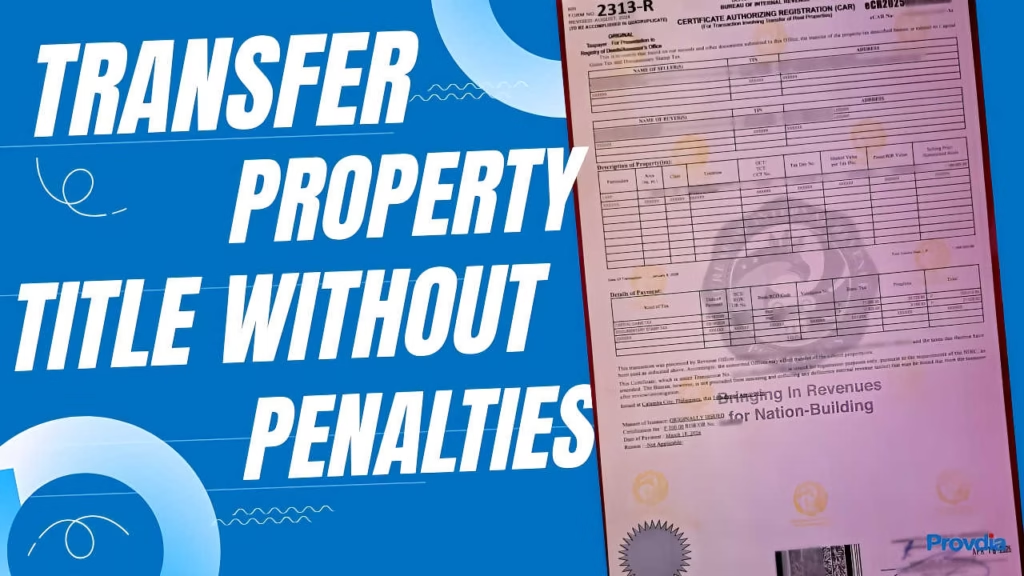
You cannot take your deed of sale directly to the land registration office. The law blocks any transfer of land ownership without tax clearance. This clearance document is called the electronic Certificate Authorizing Registration, or eCAR.
The eCAR is a security document printed on official paper with a unique barcode. It proves to the Registry of Deeds that all taxes are paid. Securing this document is the most complex part of the title transfer.
The Document Packet Checklist
To get an eCAR, you must submit a massive packet of certified documents. You submit these to the BIR office that has jurisdiction over the land.
- The original copy and photocopies of the Deed of Absolute Sale.
- A Certified True Copy of the Owner’s Duplicate Certificate of the Title.
- Certified True Copies of the Tax Declarations for the property.
- An official Certificate of No Improvement if the land is vacant.
- The Official Receipts of the real property tax payments.
- The Tax Identification Numbers (TIN) of both the buyer and the seller.
Why Applications Get Rejected
The BIR examiners inspect every single character on your documents. If there is a single mismatch, they reject your application instantly.
Spelling errors in names between the title and your ID cause immediate freezes. Typographical errors in the technical description of lot boundaries cause system rejections.
When you handle this yourself, rejection means going to the back of the line. It means driving back to the seller to ask for new IDs. It means visiting the local municipality to correct clerical errors.
Provdia uses a strict Document Audit Standard before presenting anything to the government. We inspect your papers for spelling errors and missing clearances beforehand.
If there is a problem, we fix it before submission. This ensures your eCAR moves through the pipeline without delays. You can explore our blog to see common document errors you must avoid.
Seamless Multi-Agency Navigation
A major reason why people give up on transfers is physical exhaustion. Transferring a land title is not a one-stop-shop transaction. You cannot do it all in one building.
You travel between at least four different government offices multiple times. Let us map out the route your paperwork must take.
[Notary Public] ➔ [BIR RDO Office] ➔ [Local Treasurer] ➔ [Registry of Deeds] ➔ [Assessor Office]
Step 1: The Notary Public
The buyer and seller sign the contract. A licensed notary public legalizes the document. This triggers the BIR tax clocks.
Step 2: The Bureau of Internal Revenue (BIR)
You take the notarized documents to the specific BIR branch covering that land. You line up to compute the tax. You get the assessment forms and pay at an authorized bank. You return to submit receipts and wait weeks for the eCAR.
Step 3: The Provincial or City Treasurer’s Office
Once you have the eCAR, you visit the local government treasurer. Here, you pay the Transfer Tax within 60 days of notarization. They issue a tax clearance and stamp your deed of sale.
Step 4: The Registry of Deeds (RD)
This is where the actual transfer happens. You submit the title, eCAR, transfer tax receipts, and clearances.
The Registry of Deeds verifies everything inside their digital system. If everything matches, they print a brand new Transfer Certificate of Title (TCT).
Step 5: The Municipal or City Assessor’s Office
Many buyers stop at Step 4, thinking they are done. That is a dangerous mistake. You must take your new title back to the local assessor.
You need to apply for a new Tax Declaration under your name. If you skip this, the annual property tax generates under the old owner’s name. This causes massive legal confusion later.
The Logistics Nightmare
Each of these offices operates on its own schedule. They have different lunch hours and unique queuing protocols.
If you live far away, you spend days driving back and forth. You burn money on fuel and miss hours at your job.
Provdia has field specialists who know these offices intimately. We handle the logistical nightmare for you. We know exactly which window to visit and what time to line up. We keep your documents moving across multiple agencies seamlessly.
Absolute Protection Against “Fixer” Vulnerabilities
When people realize how hard it is, they look for shortcuts. This is where the danger of “fixers” comes in.
Fixers are unauthorized individuals hanging around government buildings. They approach stressed property owners and promise to speed up processing. They claim they can bypass long lines or ignore missing documents.
Hiring a fixer is one of the most dangerous risks you take.
The Risk of Fraudulent Documents
Fixers often bypass strict government rules by fabricating documents. They might fake a tax clearance or forge a signature.
They use counterfeit documentary stamps to save themselves time. You might receive a printed piece of paper that looks real. However, inside the permanent government databases, that document does not exist.
The LRA-BIR Electronic Verification System
The Philippine government uses an advanced LRA-BIR eCAR Verification System. When you present an eCAR, the clerk scans the barcode. The system runs it through a secure digital network.
If a fixer fabricated your tax clearance, the system flags it instantly. The government freezes your transfer immediately. Even worse, you can face serious criminal charges for using falsified documents.
The Provdia Standard of Integrity
You do not need a fixer to get fast results. You need professional project management.
Provdia operates with absolute transparency. We do not use illegal shortcuts or back-end favors. We follow the official Citizen’s Charter of each agency.
We provide you with official government receipts for every peso spent. Our speed comes from preparation, clean auditing, and technical expertise. We protect your name and your property from fraud.
Opportunity Cost: What Is Your Time Worth?
Many people choose the DIY route to save money. But they fail to calculate the value of their own time. This is what economists call opportunity cost.
To complete a standard land title transfer, you sacrifice personal time. Let us look at a realistic breakdown of the hours required for a beginner:
- Research Phase: 8 hours reading blogs and trying to understand forms.
- Document Gathering: 16 hours visiting the seller and getting tax declarations.
- BIR Processing: 24 hours across multiple days lining up and paying at banks.
- Local Government Offices: 12 hours lining up for transfer taxes.
- Registry of Deeds: 12 hours submitting the final packet.
That is a total of 72 hours of physical labor. That equals nine full working days.
Calculate Your Daily Rate
If you are a professional or business owner, your time has high value. Every hour spent sitting in government corridors is an hour you are not earning money.
If your daily income rate is high, missing work costs you significantly. You are not saving money; you are actually losing it.
When you hire Provdia, you buy back your time. You stay focused on your business, your clients, or your family. We do the heavy lifting while you continue to generate income.
The Remote Ownership Solution for OFWs
This situation is even more complex for Overseas Filipino Workers (OFWs). Millions of Filipinos working abroad buy real estate back home in Laguna. They want to secure a future for their families.
But if you live abroad, you cannot physically line up at a local office. This geographic distance creates an incredible logistical barrier.
The Danger of Relying on Family Members
Many OFWs ask their relatives back home to handle the transfer. While relatives mean well, this often leads to family conflicts.
Relatives likely do not know the tax laws or deadlines. They easily miss the 30-day BIR window, triggering penalties.
Relatives have their own jobs and daily responsibilities. Forcing them to spend days in lines creates friction.
Sometimes, money sent for land taxes gets used for personal family emergencies. The taxes go unpaid, and the transfer stalls for years.
How Provdia Safeguards Remote Buyers
Provdia specializes in remote property management for global Filipinos. You do not have to fly back or burden your relatives.
We work under a secure, legally binding Special Power of Attorney (SPA). This authorizes us to process the paperwork on your behalf safely.
We provide you with regular, transparent digital updates in real-time. We ensure every peso goes directly to official government channels.
All payments are backed by legitimate receipts. With Provdia, you invest in Philippine real estate with absolute confidence.
Absolute Compliance in the Digital Era
Modern systems bring massive changes to property data processing. Government offices no longer track land titles solely via dusty paper ledgers. Today, the system is highly digitalized and interconnected.
This shift prevents land grabbing, but makes document compliance demanding.
The Modern Inspection Process
When you submit an application, systems cross-reference data instantly.
| Government Agency | Interconnected Digital System | What They Verify |
| BIR | eCAR Verification System | Verifies tax payments through banks. |
| LRA / Registry of Deeds | Title Computerization Program | Checks if electronic titles match duplicate copies. |
| LGU Assessor | Digital Mapping / GIS Systems | Verifies that lot boundaries do not overlap. |
The Consequence of Minor Errors
Because computers handle validation, there is zero room for human leniency. If a clerk inputs a document with an error, the system rejects it.
Resolving these rejections requires filing formal petitions for amendment. This adds months or even years to your timeline.
Provdia stays ahead of these digital updates. We understand the specific formatting and validation checks used by modern systems.
We prepare your documentation pack to pass these electronic filters flawlessly. This saves you from protracted digital delays. You can read our guide on digital titling to stay updated on these modern rules.
The Classroom Takeaway: The Value of Expert Protection
Land title transfer in the Philippines is governed by tight deadlines. It requires complex paperwork and has zero tolerance for errors.
| Government Agency | Interconnected Digital System | What They Verify |
| BIR | eCAR Verification System | Verifies tax payments through banks. |
| LRA / Registry of Deeds | Title Computerization Program | Checks if electronic titles match duplicate copies. |
| LGU Assessor | Digital Mapping / GIS Systems | Verifies that lot boundaries do not overlap. |
Your land title is the only evidence proving you own your property. It represents your life savings and your family’s security. Leaving its processing to chance is a gamble you cannot afford.
Hiring Provdia is a protective measure shielding your investment. We bring industry insight, systematic management, and absolute integrity to every document.
Take the Next Step Toward Secure Ownership
Do not let government red tape delay your peace of mind. Whether you are a buyer or a seller, we guide you.
Explore our website further to expand your real estate literacy. You can read our guide on how to perform initial property due diligence. You can check our article explaining procedures inside assessor offices.
Stay tuned for our upcoming e-book, The Ultimate Philippine Title Transfer Roadmap. This guide provides an exhaustive blueprint for protecting your land investments.
If you have a deed ready, let the experts handle it. Contact Provdia today for a professional document consultation. We move your property transfer across the finish line with absolute precision.